Maximus Ko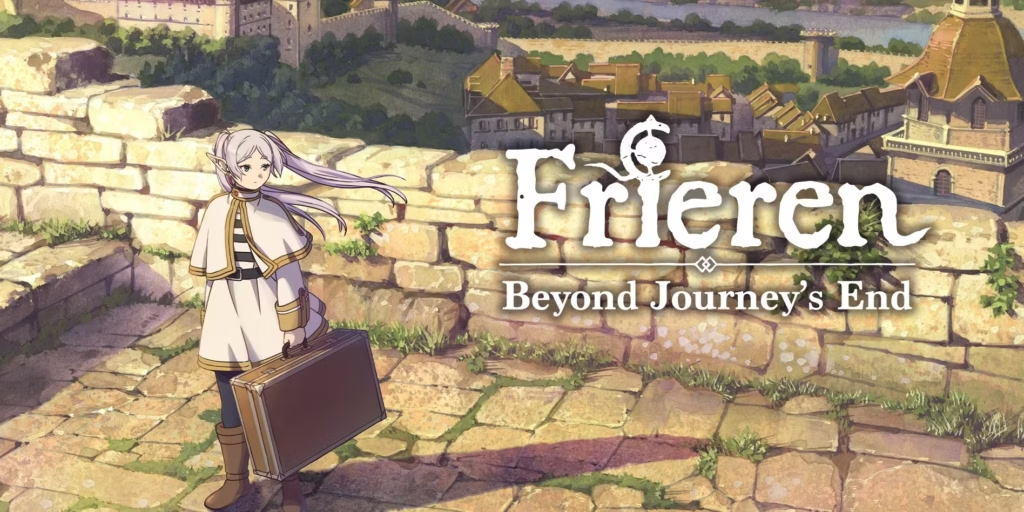
In the fall of 2023, something unusual happened in the anime community. Sousou no Frieren dethroned Fullmetal Alchemist: Brotherhood from the number one spot on MyAnimeList, a position Brotherhood had held almost uninterrupted since 2009. On its own, this was not entirely unprecedented—other anime, such as Oshi no Ko, had briefly managed the same feat. What made Frieren different, however, was that it did not quickly fall from the top. While previous challengers typically held first place for only a few weeks before settling lower on the list, Frieren stayed there, maintaining its position and continuing to resonate with viewers.
This naturally raises the question: what exactly is Frieren, and why has it become so popular?
For many years, the anime that dominated popularity charts tended to belong to the shōnen battle genre. Series like Naruto, One Piece, My Hero Academia, and Dragon Ball defined the mainstream, focusing on action, power progression, and high-stakes conflict. In 2024, however, a noticeable shift occurred. Anime that stepped outside traditional shōnen formulas began capturing widespread attention. One of the first was Oshi no Ko, a series that peeled back the curtain on the entertainment industry and openly criticized its darker aspects. Soon after came two major standouts: The Apothecary Diaries, a mystery drama set in a fictionalized Tang Dynasty–era China centered on political intrigue within the imperial rear palace, and Sousou no Frieren, also known as Frieren: Beyond Journey’s End or Frieren at the Funeral.
Frieren tells the story of an elven mage who, alongside a heroic party, defeated the Demon King and saved the world. Unlike most fantasy stories, however, the anime does not begin with the journey or the final battle. Instead, it opens after the adventure is already over, following the heroes as they return home. While combat and magic still exist within the narrative, they are not the central focus. Rather than telling a story about conquest or heroism, Frieren tells a story about time, memory, and what it means to be human.
Frieren herself is a high elf—more akin to the elves of The Lord of the Rings than anything whimsical. She is effectively immortal, having lived for over a thousand years before the story even begins. To an immortal being, time loses its urgency. Human achievements, ambitions, and relationships are often driven by the knowledge that life is finite, but Frieren exists outside that pressure. Ten years, to her, is barely a moment. This idea is reinforced through worldbuilding details, such as the explanation for why elves are so rare: because they live so long, they lack the desperation to reproduce and preserve their lineage.
This difference in perspective is what propels the story forward. When the hero’s party returns after their ten-year journey, the event represents the defining adventure of a lifetime for Frieren’s companions. For Frieren, however, it feels insignificant—until reality catches up to her. When one of her former party members dies of old age, she is forced to confront the fact that while her time may be endless, everyone else’s is not. For the first time, she realizes how little she truly understood the people she traveled with and how easily moments can be lost when they are taken for granted.
At its core, Frieren is a story about an immortal learning how to live as a mortal. It is about forming attachments, cherishing fleeting moments, and understanding that meaning comes not from endless time, but from how that time is spent. In a world where many people feel trapped in routine, disconnected, or overwhelmed by the passage of days, Frieren resonates deeply. It reminds viewers that life is finite, moments are fragile, and that perhaps we should slow down and appreciate the people and experiences we still have.
That quiet, reflective message—rather than spectacle or action—is what has allowed Sousou no Frieren to achieve something rare: lasting, widespread acclaim that cuts across genres and audiences alike.